Euro Trip Itinerary Tips: How to Balance Budget and Experience
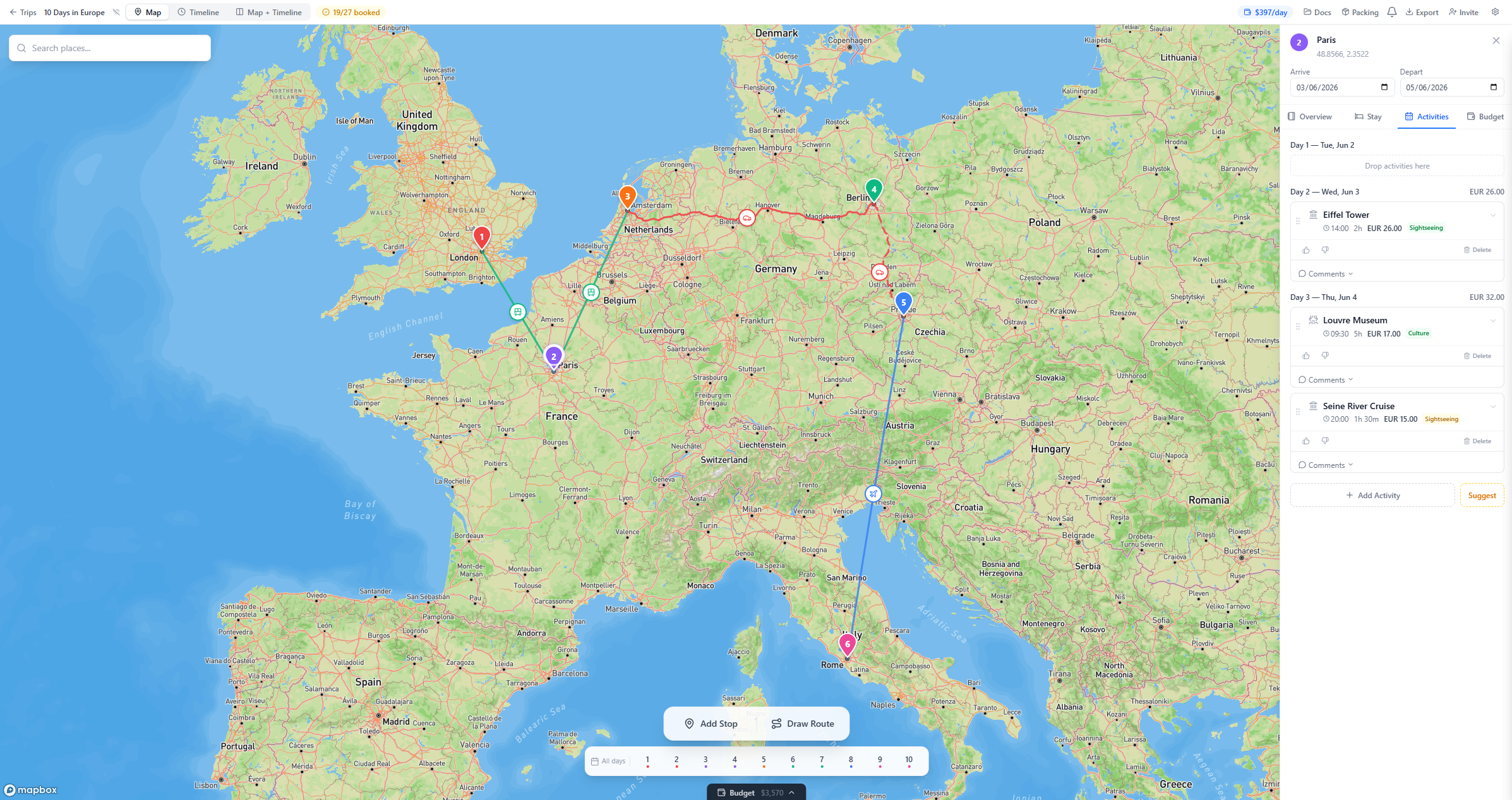
A two-week euro trip costs 1,500–5,000 EUR per person — and the difference comes down to smart choices, not sacrifices. Set 2–3 trip priorities before booking, route your itinerary geographically to cut hidden transport costs, travel in shoulder season (May–June or September–October) for 20–40% savings, and track spending daily with a multi-currency budget tool.
These euro trip itinerary tips will help you plan a European trip that feels rich without draining your savings.
Set your euro trip priorities before you book anything
The biggest budget mistake on a euro trip is trying to do everything. Europe has too many cities, too many museums, and too many rooftop bars for any single itinerary. Trying to fit them all in leads to rushed travel days, expensive last-minute bookings, and exhaustion.
Pick up to three priorities for the trip. Maybe it is food in Italy, history in Greece, or nightlife in Berlin. Write them down. When a choice comes up — should we add another city? Should we upgrade the hotel? — test it against your list. If it supports a priority, consider it. If not, save the money.
This works even better when you travel with a group. A shared priority list prevents the “let’s just add one more stop” spiral that inflates budgets and compresses schedules. Tools like Plot a Trip let everyone see the itinerary and budget in one place, so the group stays aligned without endless WhatsApp debates.
Plan your euro trip route to cut hidden costs
European cities are close together, but the wrong route order can cost you hundreds in backtracking. A Paris → Barcelona → Amsterdam itinerary forces you south then back north. Paris → Amsterdam → Barcelona flows naturally and saves a flight or long train ride.
Drop your must-visit cities onto a map and look at the geography before booking anything. Group nearby cities into clusters: Benelux (Amsterdam, Brussels, Bruges), Central Europe (Prague, Vienna, Budapest), Mediterranean (Barcelona, Nice, Rome). Moving between clusters is where the big transport costs live, so minimize those jumps.
For each stop, note why you are going and roughly how long you need. One night in a transit city is fine. Three nights in a place with your top priority activity is worth it. This prevents the common mistake of spending equal time everywhere regardless of what is actually there.
Build in buffer days. A missed train connection in Europe is not a disaster if you have flexible days built into the plan. Without them, one delay cascades into rebooking costs and missed reservations.
Choose European transport strategically
Transport is typically 25-35% of a European trip budget. The right choices here create the biggest savings.
Eurail passes vs. point-to-point tickets. A 7-day Eurail Global Pass costs around 280 EUR. Compare that against buying individual tickets for the same routes. For trips with 4+ train journeys across borders, the pass usually wins. For 2-3 short domestic trips, point-to-point is cheaper — especially when booked 4-6 weeks ahead on sites like Trainline or the national rail operators (DB, SNCF, Trenitalia).
Budget airlines. Ryanair and EasyJet connect most European cities for 20-60 EUR if you book early and travel light. But add a carry-on bag (25 EUR), airport transfers (15-30 EUR each way), and the time cost of airports outside city centers, and the “cheap” flight is often comparable to a train. Always compare door-to-door cost and time.
Buses for the budget-conscious. FlixBus connects hundreds of European routes at 10-30 EUR. The trade-off is time — a 6-hour bus replaces a 2-hour train. Worth it for overnight routes where you save a night of accommodation. Less worth it for daytime travel that eats into sightseeing hours.
The golden rule: Book inter-city transport first, then build your daily itinerary around arrival and departure times. This prevents the expensive mistake of booking a morning museum tour and then discovering the only affordable train arrives at noon.
Book European accommodation that matches the stop
Not every night of a euro trip needs the same type of accommodation. Match the stay to what you are doing in that city.
Central splurge nights — When your priorities are in the city center (Rome’s historic core, central Amsterdam), pay more for location. Walking to everything saves 10-20 EUR per day in metro tickets and taxis, and you get more hours of sightseeing instead of commuting.
Budget neighborhood nights — When the city is a transit stop or you mostly want evening atmosphere, book in a residential neighborhood 15-20 minutes from center. In cities like Lisbon, Budapest, and Berlin, neighborhoods like Alfama, the Jewish Quarter, or Kreuzberg are cheaper, more authentic, and well-connected by public transport.
Hostel social nights — If you are solo or want to meet people, hostels like Generator or St Christopher’s run 25-40 EUR per night in most European cities and include common areas, bars, and organized events. Private rooms in hostels run 60-90 EUR — less than most hotels.
Check what is included before booking. A 70 EUR hotel with breakfast, laundry, and no city tax can be cheaper than a 55 EUR Airbnb where you eat out every morning and pay 3 EUR per night in local fees.
Eat well across Europe without overspending
Food is one of the best parts of traveling in Europe, and you do not need to overspend to eat well. The trick is structure.
The 1-1-1 rule: One cheap meal (bakery, supermarket, or street food for 3-8 EUR), one mid-range meal (local restaurant, 12-20 EUR), and one splurge meal per trip stop where you do not worry about cost. This keeps daily food spending around 25-40 EUR while still hitting the memorable meals.
Country-specific tips:
- Italy: Eat the 1.50 EUR espresso standing at the bar (not seated — that is 4 EUR). Lunch at a trattoria with a fixed-price menu (pranzo) runs 10-14 EUR for two courses.
- Spain: Eat late like locals. Lunch menus (menú del día) cost 10-15 EUR for three courses and a drink. Tapas at dinner can add up fast — set a per-bar limit.
- Germany: Doner kebabs (4-6 EUR) and bakery pretzels (1-2 EUR) are the budget traveler’s best friends. Beer in a biergarten is cheaper than a cocktail anywhere.
- Eastern Europe: Your money goes much further. A full restaurant meal in Budapest, Prague, or Krakow runs 8-15 EUR. Budget travelers can eat three restaurant meals a day and still spend less than one dinner in Paris.
Shop at local supermarkets (Lidl and Aldi are across the continent) for breakfast supplies and picnic lunches. A baguette, cheese, and fruit from a French market costs 5 EUR and tastes better than most tourist restaurant lunches.
Budget for European activities with a tier system
Not every European attraction is worth its ticket price, and some of the best experiences are free. Use a simple tier system to allocate your activity budget.
Tier 1 — Worth full price. These are the experiences central to your trip priorities. The Uffizi in Florence (25 EUR), a Gaudi tour in Barcelona (26 EUR), or a guided walking tour of Berlin’s history (15-20 EUR). Book these in advance — many sell out, and advance tickets are often 5-10 EUR cheaper.
Tier 2 — Worth it with a discount. City passes like the Paris Museum Pass (62 EUR for 4 days) or the Roma Pass (33 EUR for 48 hours) save money if you plan to visit 3+ included sites. Do the math first — sometimes you only want one or two things and individual tickets are cheaper.
Tier 3 — Free or nearly free. Walking historic neighborhoods, public parks, free museum days (French national museums are free on the first Sunday of the month, and many cities have similar programs — check locally), churches, markets, viewpoints. These often end up being trip highlights. No ticket required for sunset at Montmartre or a walk through Prague’s Old Town.
Add up your Tier 1 and Tier 2 costs and include them in your daily budget. Knowing the big-ticket items up front prevents the “I’ve already spent too much” anxiety that makes the last few days of a trip feel restricted.
Use European timing and seasonality to save
The difference between peak and shoulder season in Europe is dramatic — both in price and experience.
Shoulder season sweet spots: May-June and September-October offer warm weather, fewer crowds, and prices 20-40% lower than July-August. A hotel room in Santorini that costs 200 EUR per night in August drops to 110 EUR in early October. Shoulder season also means shorter queues at major attractions.
Day-of-week pricing. Flights within Europe are cheapest Tuesday through Thursday. Hotels in business cities (Frankfurt, Milan) drop on weekends. Hotels in leisure cities (Barcelona, Dubrovnik) drop midweek. Shifting arrival days by one or two can save 15-25% on accommodation.
Free day strategy. Build one or two unplanned days into your itinerary. Use them for whatever feels right — a local recommendation, a day trip that was not on the original plan, or simply resting so you actually enjoy the second week. These flexible days also serve as insurance against weather, closures, or the unexpected gems that make European travel special.
Track your euro trip budget with the right tools
The “I’ll figure it out later” approach to euro trip budgeting leads to one of two outcomes: anxiety about every purchase, or a credit card statement that is painful to open at home.
Set a clear daily budget before you leave. For Western Europe, 80-120 EUR per day covers accommodation, food, transport, and activities at a comfortable mid-range level. For Eastern Europe, 40-70 EUR per day buys the same quality. Know your number and track against it.
Multi-currency tracking matters in Europe. Even within the eurozone, you will encounter different price levels — a coffee costs 1.20 EUR in Lisbon and 4.50 EUR in Copenhagen. If your trip includes non-euro countries (UK, Switzerland, Czech Republic, Hungary, Poland), you are juggling 3-4 currencies. A tool that handles automatic conversion saves real headaches.
Plot a Trip handles this with a shared budget tracker that auto-converts between currencies and lives alongside your map and itinerary — so when you log 450 CZK for dinner in Prague, your group sees the EUR equivalent instantly without anyone pulling out a calculator. If you prefer something simpler, even a daily note on your phone with “spent X today” keeps you honest.
If you are currently juggling Splitwise, Google Sheets, and a map app to plan your trip, you might recognize the fragmentation problem — and why consolidating tools matters.
Review your spending at the midpoint of the trip. If you are over budget, trim the small daily costs (fewer coffees out, one more supermarket lunch) and protect the big experiences. If you are under, reward yourself with a Tier 1 experience you were on the fence about.
Think local for better value and better experiences
The cheapest option and the most authentic option are often the same thing in Europe.
Eat where locals eat, not where the menu is translated into six languages. Take the regional bus instead of the tourist shuttle. Book a room in a neighborhood, not a hotel on the main square. These choices save money, but more importantly, they give you a trip that feels like Europe instead of a theme park version of it.
Support local businesses where you can. A 15 EUR guided tour from a local history graduate is usually more engaging than a 45 EUR corporate bus tour — and more of your money stays in the community. Neighborhood restaurants, family-run guesthouses, and local market vendors provide better value and more genuine interactions than their tourist-district equivalents.
Key takeaways
The best euro trip itinerary tips come down to a few principles: set clear priorities, plan your route geographically, book transport and stays that match each stop’s purpose, and track your spending as you go.
Small choices compound. Shoulder season saves 20-40%. Cooking breakfast saves 5-10 EUR per day. Booking trains 4 weeks ahead saves 30-50% per ticket. Over two weeks, these add up to hundreds of euros — money that goes toward the experiences you actually care about.
Plan smart, spend on what matters, skip what does not. One map, one budget, one itinerary. Start planning free.
Related reading: See our picks for the top 5 must-see cities on your euro trip, or find out why your trip planning tool stack is more complex than it needs to be.